
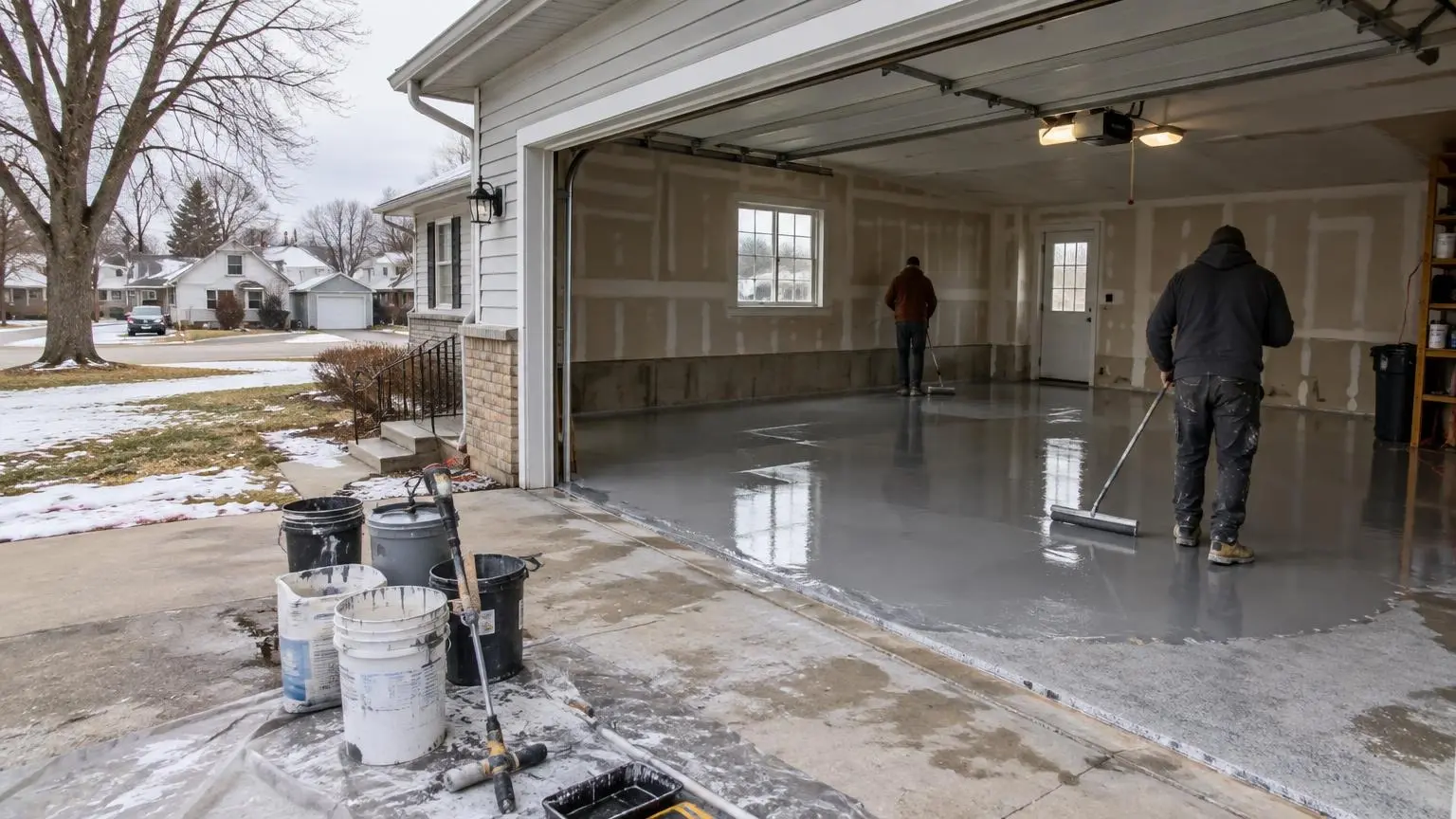
Quicker return to service
Polyaspartic Floor Coating in Waterloo, IA
Park sooner, coat later into the fall, and keep a clear finish that resists sun and abrasion.
- Free on-site estimates with a slab moisture check
- Itemized written quote before any grinding starts
- Every floor diamond ground and patched before it is coated
When Polyaspartic Makes Sense in Waterloo
Polyaspartic floor coating is a fast-curing resin in the polyurea family. It is used on its own or as a topcoat over an epoxy base. In Waterloo it earns its place for two reasons: it cures quickly, so the garage is out of service for less time, and it tolerates cold far better than standard epoxy. HomeGuide lists polyaspartic with an application range of -30°F to 140°F and a full cure, ready for vehicles, in 24 to 48 hours.
How it compares with epoxy
Epoxy goes on thick, often 10 to 20 mils per coat, and bonds very well to ground concrete. It cures slowly, and standard epoxy has poor to fair resistance to UV, so it can yellow in sunlight. Polyaspartic goes on thinner, about 2 to 6 mils per coat in HomeGuide's comparison, sets fast, and holds its color in sun. Many of the floors we install use both: an epoxy base for build and bond, with a polyaspartic topcoat for wear and UV.
Cold-weather coating
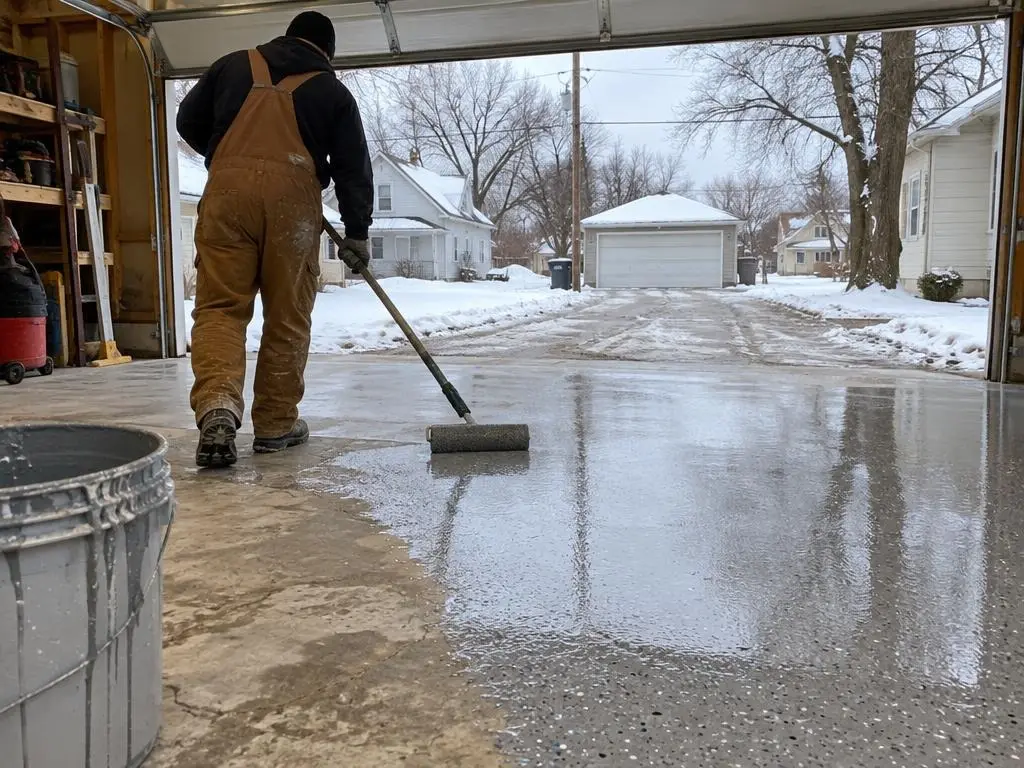
Iowa's coating season is shorter than it is in warmer states. Waterloo's January normal mean is 18.5°F, and unheated garages stay cold well into spring. Standard epoxy slows down or fails to cure properly when the slab is too cold. Polyaspartic keeps working at lower temperatures, which lets us coat garages later in the fall and earlier in the spring. We still check slab temperature and dew point on the day, because a cold slab can sweat, and coatings will not bond to a wet surface.
Speed has a trade-off
Polyaspartic sets quickly once it is mixed, so it has to be applied in small batches by a crew that is ready. It is not forgiving for do-it-yourself work. It also costs more per square foot than epoxy. HomeGuide puts installed polyaspartic at $5 to $12 per square foot against $4 to $10 for epoxy.
Good fits for polyaspartic
- Garages where you need the car back inside quickly
- Fall and spring jobs when the slab is cool
- Floors near large doors that let in direct sun
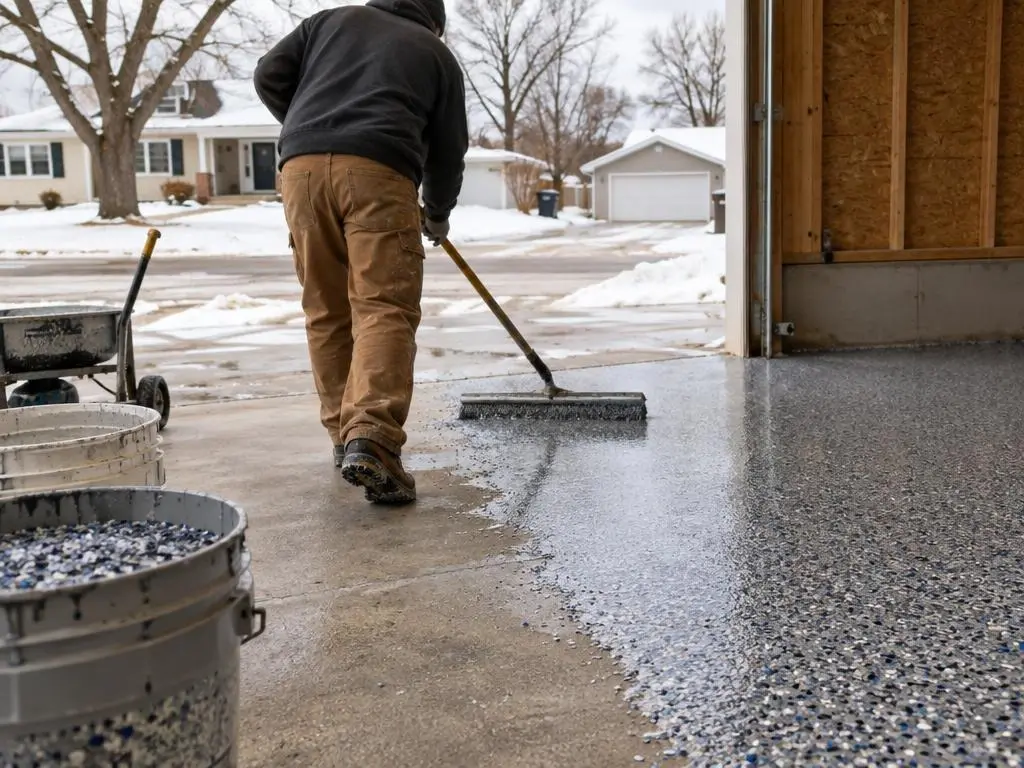
- A topcoat over flake or metallic epoxy for scratch and UV resistance
- Small commercial spaces that cannot close for long
Prep stays the same
Fast cure does not change the basics. A polyaspartic floor still needs a diamond-ground slab, filled cracks, and a clean, dry surface. A thin, fast coating applied over a poorly prepared floor peels just as quickly as any other.
How long it lasts
HomeGuide gives polyaspartic a residential lifespan of 10 to 20 years or more, depending on traffic and care. Squeegeeing meltwater and rinsing salt off during the winter helps it last.
What This Covers
A polyaspartic job can be a full system or a topcoat over another finish.
Full polyaspartic system
Primer, color or flake coat and clear topcoat, all polyaspartic, for the fastest return to use.
Epoxy base with polyaspartic top
A thick epoxy base for bond and build, finished with a UV-stable, abrasion-resistant clear coat.
Cold-season installs
Slab temperature and dew point checked, and the space heated if needed, so the coating cures properly.
Moisture testing
Tests before coating, with a moisture-mitigating primer where the slab needs it.
Typical Polyaspartic Floor Coating Costs
| Item | Published range |
|---|---|
| Per square foot (HomeGuide) | $5 to $12 |
| Per square foot (Bob Vila) | $4 to $9 |
| One-car garage (288 to 392 sq ft) | $1,400 to $4,700 |
| Two-car garage (400 to 576 sq ft) | $2,000 to $6,900 |
| Three-car garage (576 to 864 sq ft) | $2,900 to $10,400 |
| Moisture and hardness testing | $50 to $300 |
| Moisture barrier, if needed | about $1 extra per sq ft |
National ranges from HomeGuide's polyaspartic cost guide and Bob Vila. Local prices can differ, and repairs, old coatings, flake and moisture work change the total. Your written estimate is the price.
How It Works
1. Check the slab and conditions
We test moisture and measure slab temperature, and plan around the weather that week.
2. Grind and repair
Diamond grinding, vacuuming, and crack and pit repair before any coating.
3. Apply in batches
Polyaspartic is mixed and spread in small batches because it sets quickly.
4. Back in service
Foot traffic within hours and vehicles typically within one to two days.
Polyaspartic Floor Coating Questions
Is polyaspartic better than epoxy?
Each has strengths. Epoxy builds thickness and bonds well. Polyaspartic cures faster, resists UV and can be applied in colder weather. Many floors use an epoxy base with a polyaspartic topcoat to get both.
How soon can I drive on a polyaspartic floor?
HomeGuide says full cure for vehicles is 24 to 48 hours. Bob Vila's guide says about 24 hours. Cold slabs slow curing, so we give you a specific time for your floor.
Can polyaspartic be installed in an Iowa winter?
It tolerates much colder application than standard epoxy; HomeGuide lists -30°F to 140°F. The slab still has to be dry and above the dew point, so we check conditions on the day and heat the space when needed.
Why does polyaspartic cost more?
The material costs more and it has to be applied quickly in small batches. HomeGuide puts it at $5 to $12 per square foot installed, compared with $4 to $10 for epoxy.
Polyaspartic Floor Coating Service Areas
- Epoxy Flooring in Waterloo, IA
- Epoxy Flooring in Cedar Falls, IA
- Epoxy Flooring in Evansdale, IA
- Epoxy Flooring in Elk Run Heights, IA
- Epoxy Flooring in Raymond, IA
- Epoxy Flooring in Gilbertville, IA
- Epoxy Flooring in Hudson, IA
- Epoxy Flooring in La Porte City, IA
- Epoxy Flooring in Dunkerton, IA
- Epoxy Flooring in Waverly, IA
- Epoxy Flooring in Denver, IA
- Epoxy Flooring in Janesville, IA
- Epoxy Flooring in Dike, IA
- Epoxy Flooring in Parkersburg, IA
- Epoxy Flooring in New Hartford, IA
Get a Polyaspartic Floor Coating Estimate
Need the garage back fast? Get a free polyaspartic estimate.