
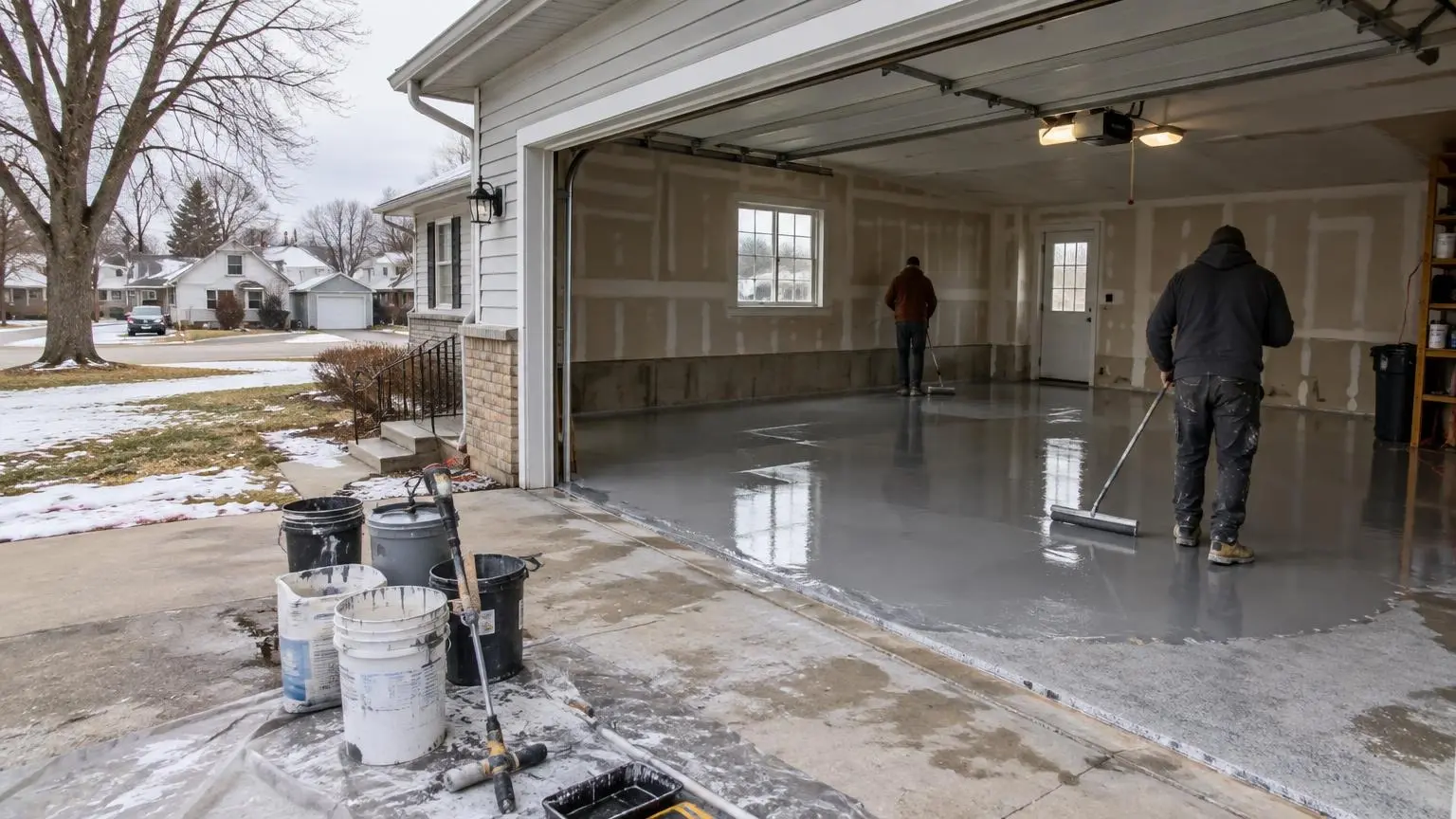
Single, double and triple stall garages
Garage Floor Coating in Waterloo, IA
A sealed slab you can squeegee clean after every storm, from the door seal to the back wall.
- Free on-site estimates with a slab moisture check
- Itemized written quote before any grinding starts
- Every floor diamond ground and patched before it is coated
Coating the Garage for an Iowa Winter
Garage floor coating in Waterloo has one main job: keep winter out of the concrete. January here averages 18.5°F, per Wikipedia's climate figures, and the city sees about 35 inches of snow a year. Each trip home drops a little slush and salt on the slab. Bare concrete drinks that water in. A bonded resin coating seals the surface, so meltwater sits on top until you push it out the door.
The strip by the door
Most garage damage we see in the Cedar Valley starts in the first few feet past the overhead door. Snow melts off the bumper, then freezes again when the door opens on a cold morning. Salt keeps that water liquid longer and leaves crystals behind as it dries. Over several winters the strip turns rough, then scaly, then pitted. We repair it before coating, because resin can only grip concrete that is still solid.
Factory City garages
Waterloo grew around manufacturing. Deere has built tractors here since 1893, and much of the housing went up in the decades that followed. Census survey numbers summarized by Point2Homes put the median Waterloo home at 1962, with 21.6 percent built in 1939 or earlier. Many of those homes have a detached one- or two-stall garage on an older pad. Those slabs tend to be thin and cracked, and some have settled at a corner. Cedar Falls is younger, with a median build year of 1975, and its attached garages usually have flatter concrete. We plan the grinding and patching around the slab you actually have.
Store kits versus ground concrete
The home stores in Waterloo and Cedar Falls stock plenty of garage epoxy kits. Most rely on an acid wash, which cleans the top but leaves salt-damaged concrete and old sealer in place. Hot tires then lift the thin film in the drive paths. We diamond grind every square foot, edges and corners included, vacuum the dust, degrease oil spots and fill cracks and pits. If a kit or paint job is already peeling, all of it comes off first.
Matching the fix to the floor
- Rough or pitted concrete near the door: grind and patch that strip, then coat
- White rings where puddles dried: cut the salt residue away in the grind
- A peeling kit or painted floor: strip it before anything new goes down
- Oil soaked into the tire paths: degrease and grind until clean concrete shows
- Cracks, broken joints or a sunken corner: fill, level and grind flush
Finish choices
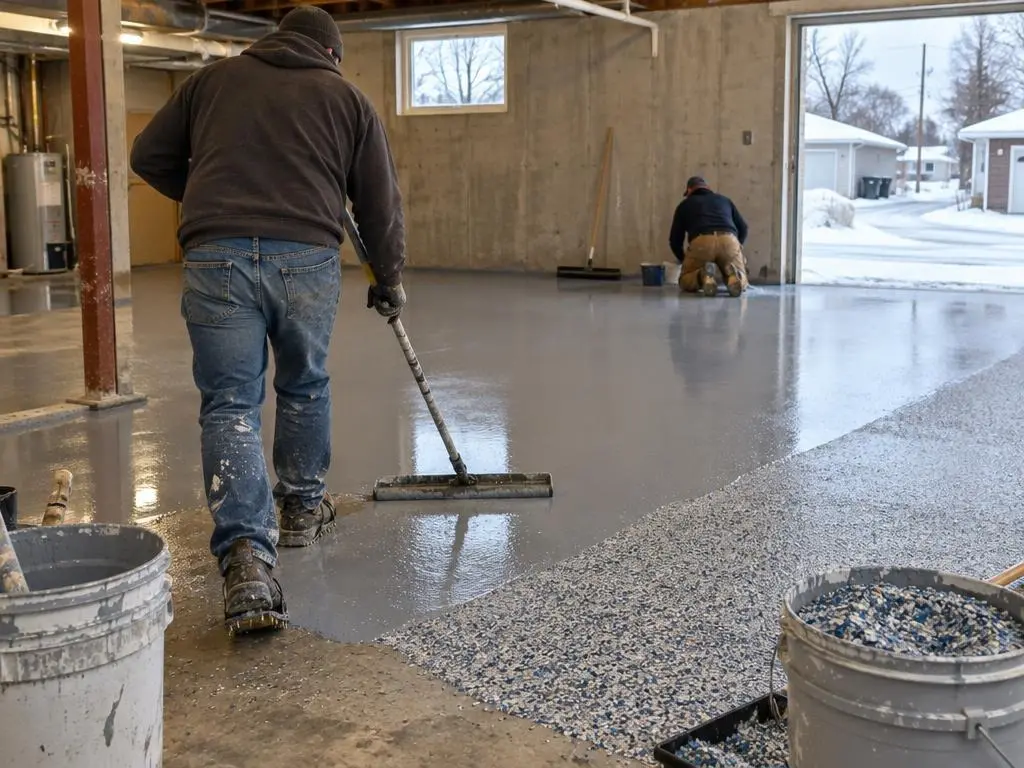
A full flake broadcast is the most common pick in Cedar Valley garages, because it hides dried salt and leaves some texture underfoot. A solid color with a light chip scatter looks cleaner. Either one can carry a polyaspartic clear coat, which resists wear and sunlight and lets you park sooner than standard epoxy. We bring sample boards so you can judge them under your own garage light.
Timing around cold weather
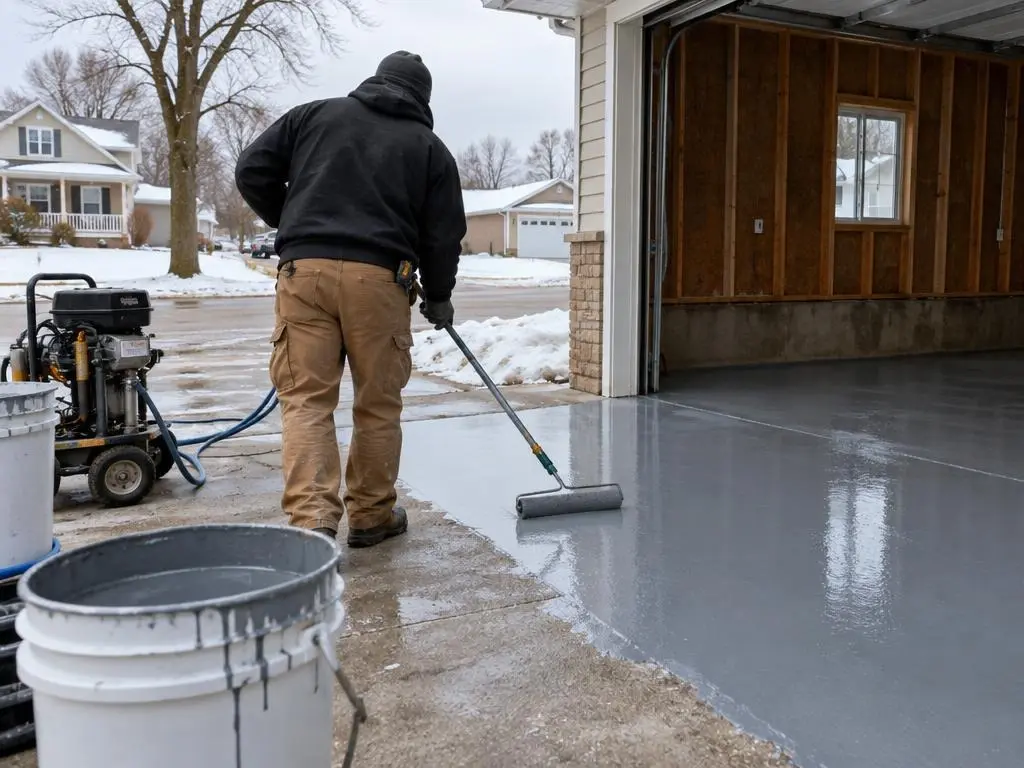
Many garages here are unheated, and resin needs a slab warm enough to cure. HomeGuide lists polyaspartic as workable from -30°F to 140°F. Standard epoxy wants a warmer floor. In late fall and winter, we check the slab temperature before we commit to a date and choose the product that fits.
Habits that help the floor last
A coating makes winter cleanup quick, but salt still deserves attention. Keep a floor squeegee by the door and clear slush after each storm. Hose the floor down a few times a season so brine does not dry into a film. A plastic shovel blade is kinder to the topcoat than steel.
Included in a Garage Coating
Every garage job covers the whole slab, from the door seal back to the house step.
Full-floor grind
Diamond grinding that removes salt-weakened concrete, sealers, paint and kit coatings.
Patching
Pits, spalls, cracks and broken joints filled, then ground level with the slab.
Coating system
Epoxy base, a chip or solid color layer and a clear topcoat picked for the space.
Curbs and steps
Optional coating on the short stem wall along the sides and on the step into the house.
Garage Coating Price Ranges
| Size or item | National published range |
|---|---|
| Epoxy, installed, for each sq ft | $4 to $10 |
| Single-stall garage in epoxy, 288 to 392 sq ft | $1,200 to $3,900 |
| Double-stall garage in epoxy, 400 to 576 sq ft | $1,600 to $5,800 |
| Triple-stall garage in epoxy, 576 to 864 sq ft | $2,300 to $8,600 |
| Double-stall garage in polyaspartic | $2,000 to $6,900 |
| Patching chips and small cracks | $25 to $250 |
Ranges come from HomeGuide's epoxy and polyaspartic cost guides, plus HomeAdvisor's concrete coating guide for patching. They are national numbers. Salt damage, an old coating to strip and the finish you pick all move the total in Waterloo. The written estimate is the price.
How a Garage Job Goes
1. Look and measure
We note scaling, cracks, oil, moisture and any old coating, and check the slab temperature.
2. Prep
Diamond grind, vacuum, degrease and fill every pit and crack flush.
3. Apply
Base, chips or color, and topcoat go down over one or two days.
4. Cure
You get written times for walking on it, moving storage back and parking.
Garage Floor Coating Questions
What does a two-stall garage coating run in Waterloo?
HomeGuide's national range is about $1,600 to $5,800 for epoxy and $2,000 to $6,900 for polyaspartic. Salt-damaged concrete, an old coating to remove and the finish you pick all move the number. You get a written price after we see the floor.
Can you coat my garage in November?
Often, yes. We check the slab temperature first. Polyaspartic handles cold far better than standard epoxy, so it is the usual choice late in the year. If the slab is too cold for any product, we book a warmer week.
My detached garage floor is cracked and uneven. Can it still be coated?
Usually. Cracks get filled and ground flush, and low spots can be built up. A section that has heaved or a crack that keeps widening is a concrete problem, and we tell you so before you spend money on a coating.
When can the car go back in?
It depends on the product and the weather. Bob Vila's polyaspartic guide puts vehicles back on after about 24 hours, compared with about three days for standard epoxy. HomeGuide gives 2 to 7 days for epoxy. We write down the time for your floor.
Garage Floor Coating Service Areas
- Epoxy Flooring in Waterloo, IA
- Epoxy Flooring in Cedar Falls, IA
- Epoxy Flooring in Evansdale, IA
- Epoxy Flooring in Elk Run Heights, IA
- Epoxy Flooring in Raymond, IA
- Epoxy Flooring in Gilbertville, IA
- Epoxy Flooring in Hudson, IA
- Epoxy Flooring in La Porte City, IA
- Epoxy Flooring in Dunkerton, IA
- Epoxy Flooring in Waverly, IA
- Epoxy Flooring in Denver, IA
- Epoxy Flooring in Janesville, IA
- Epoxy Flooring in Dike, IA
- Epoxy Flooring in Parkersburg, IA
- Epoxy Flooring in New Hartford, IA
Get a Garage Floor Coating Estimate
Free on-site garage floor estimates in Waterloo, Cedar Falls and the Cedar Valley.